The Smith Edison offers a payload of 2925 pounds, and a range of 150 miles per charge! I can imagine this vehicle delivering such things as supplies and mail too and around military bases in friendly countries.
http://www.smithelectricvehicles.com/products.asp?p=Edison
The Smith Newton can carry payloads up to 3.5 tons! And has a range of 130 miles per charge! It would be ideal for delivering such things as fuel, and spare parts too and around bases in friendly countries.
http://www.smithelectricvehicles.com/products.asp?p=NT
The Smith Faraday, has a payload of greater then two tons! The great thing about the Faraday is its variety of potential uses, it could be used as a recycling and trash pickup truck, while also having potential to deliver much needed supplies that need refigeration.
http://www.smithelectricvehicles.com/products.asp?p=Faraday
I think the US Military should be investing in such trucks. With modifications these trucks might even be able to operate in combat environements! Therefore saving the military hundreds of millions (if not billions) of dollars a year in transportation costs! And with much fewer parts then conventional diesel delivery trucks, the savings in maintenance costs would be astonishing!
Showing posts with label DOD Energy Strategy. Show all posts
Showing posts with label DOD Energy Strategy. Show all posts
Monday, February 4, 2008

Thursday, July 26, 2007
US Air Force, renewable energy for planes program!
The Air Force Office of Scientific Research here recently awarded the University of Washington and three partner universities a grant worth approximately $6 million over 5 years to study the design of air vehicles capable of collecting and storing solar and heat energies.
One of the goals of the research is to enhance Air Force air vehicle systems but there are many potential applications in other areas such as space platforms
While running air vehicles or space platforms, there are presently three main sources for harvesting energy with non-fossil origins – sunlight, heat, and vibration,” said Dr. B. L. “Les” Lee, program manager at AFOSR’s Aerospace and Material Sciences Directorate. The source of the heat energy, he said, can be aerodynamic heating caused by high flying speed or the recycling of waste heat around an aircraft cabin or engine. Each of the three sources, he explained, is capable of generating electricity, but sunlight and heat energies show the greatest potential in terms of significant power output. As a result, the proposed research will focus primarily on these two energy sources
Researchers will explore a variety of topics concerning materials and micro devices associated with so-called photovoltaic energy – or electricity generated from light sources – and thermoelectric energy – or electricity generated from heat sources. Once fully developed, these systems may one day enable air vehicles to fly solely on solar energy and aerodynamic heat. The systems may also find application in cabin operation on commercial airplanes
http://www.afosr.af.mil/News/nr_2006_29_solarHeatEnergies.htm
This is so awesome! First we use it in unmanned planes, then we use it in small manned planes. And then we just keep on progressing. Even if it didn't soley power an airplane, it could still reduce gas money! Looks like the Air Force is thinking smart now I tell ya. Although the money there allocating is pretty small. Hey you have to start somewhere! And here is the cool thing! If Air Force planes could be electricaly charged eventually. They could run on that for a little bit, intill the solar and thermal energy harvesting systems kicked in! I mean just think how quiet electric cars are, now apply that to a plane. I mean that would probably give a steath advantage of some sort. Another thing it would help with is thermal signature. Electric cars don't give off emmisions, electric planes won't either. And last but not least, the money savings. There will probably be four phases this technology will mature through.
1. Unmanned Aircraft Unmanned aircraft are usually pretty small and don't have half as much power needs as regular manned aircraft. Just think if we could power our unmanned fleet with solar and thermal energy. The money savings for fuel would probably be at least in the tens if not the hundreds of millions of dollars. This technology would also provide us with a potential to keep borders, etc, under surveliance for long periods of time.
2. Small Aircraft An example of a small aircraft would be the F22 Raptor, or JSF. The savings for using no fuel in these aircraft would be in the hundreds if not the billions of dollars.
3. Medium aircraft. The B2 Spirit or B52 bomber would be a medium sized aircraft. The savings for these aircraft would be the same as phase 2.
4. Big Aircraft. The C-130 or the AWACS, or even the JSTAR. Would be in this category. The savings would be on the phase two scale.
One of the goals of the research is to enhance Air Force air vehicle systems but there are many potential applications in other areas such as space platforms
While running air vehicles or space platforms, there are presently three main sources for harvesting energy with non-fossil origins – sunlight, heat, and vibration,” said Dr. B. L. “Les” Lee, program manager at AFOSR’s Aerospace and Material Sciences Directorate. The source of the heat energy, he said, can be aerodynamic heating caused by high flying speed or the recycling of waste heat around an aircraft cabin or engine. Each of the three sources, he explained, is capable of generating electricity, but sunlight and heat energies show the greatest potential in terms of significant power output. As a result, the proposed research will focus primarily on these two energy sources
Researchers will explore a variety of topics concerning materials and micro devices associated with so-called photovoltaic energy – or electricity generated from light sources – and thermoelectric energy – or electricity generated from heat sources. Once fully developed, these systems may one day enable air vehicles to fly solely on solar energy and aerodynamic heat. The systems may also find application in cabin operation on commercial airplanes
http://www.afosr.af.mil/News/nr_2006_29_solarHeatEnergies.htm
This is so awesome! First we use it in unmanned planes, then we use it in small manned planes. And then we just keep on progressing. Even if it didn't soley power an airplane, it could still reduce gas money! Looks like the Air Force is thinking smart now I tell ya. Although the money there allocating is pretty small. Hey you have to start somewhere! And here is the cool thing! If Air Force planes could be electricaly charged eventually. They could run on that for a little bit, intill the solar and thermal energy harvesting systems kicked in! I mean just think how quiet electric cars are, now apply that to a plane. I mean that would probably give a steath advantage of some sort. Another thing it would help with is thermal signature. Electric cars don't give off emmisions, electric planes won't either. And last but not least, the money savings. There will probably be four phases this technology will mature through.
1. Unmanned Aircraft Unmanned aircraft are usually pretty small and don't have half as much power needs as regular manned aircraft. Just think if we could power our unmanned fleet with solar and thermal energy. The money savings for fuel would probably be at least in the tens if not the hundreds of millions of dollars. This technology would also provide us with a potential to keep borders, etc, under surveliance for long periods of time.
2. Small Aircraft An example of a small aircraft would be the F22 Raptor, or JSF. The savings for using no fuel in these aircraft would be in the hundreds if not the billions of dollars.
3. Medium aircraft. The B2 Spirit or B52 bomber would be a medium sized aircraft. The savings for these aircraft would be the same as phase 2.
4. Big Aircraft. The C-130 or the AWACS, or even the JSTAR. Would be in this category. The savings would be on the phase two scale.
Wednesday, April 18, 2007
Renewable Energy at Guantanamo Naval Base
Standing 275-foot tall, with blades spanning 177 feet, the Navy's four new 3-blade wind turbines are among the most noticeable features at Naval Station Guantanamo Bay, Cuba. Each of the four turbines will generate 950 kilowatts (kw) of electricity. Together, the four turbines will generate 3,800 kw, and in years of typical weather the wind turbines will produce almost 8 million kilowatt-hours of electricity. They will reduce the consumption of 650,000 gallons of diesel fuel, reduce air pollution by 26 tons of sulfur dioxide and 15 tons of nitrous oxide, and reduce greenhouse gas emissions by 13 million pounds each year.
The new wind turbines will provide as much as 25% of the base's power generation during the high-wind months of late summer, and are expected to save taxpayers $1.2 million in annual energy costs. The project began in July 2004 and cost nearly $12 million. Construction of the wind energy project was made possible through a partnership between the Navy and NORESCO of Westborough, MA as part of an energy savings performance contract (ESPC).
http://www.defenseindustrydaily.com/2005/04/wind-power-debuts-at-gitmo/
Here is what I am wondering, if four turbines provide 25% of the bases energy in good wind conditions. Then wouldn't 16 wind turbines provide 100% power to the base in good wind conditions?
"Before the wind turbines, Guantanamo Bay spent $31,000 a day -- $24 a minute -- on diesel fuel to run generators around the clock to produce electricity. Since the turbines went into operation about six weeks ago, they have been providing between 5 and 12 percent of the power the base uses.
Johnston noted that spring is the "slack-wind period" and that the turbines would be able to produce more power by July."
http://www.defenselink.mil/news/newsarticle.aspx?id=31070
With 16 turbines, the slack wind period energy for the base would theoretically increase to around 50 %. This would result in substantial energy savings. With say 24 wind turbines in operation it would increase theoretically to 75% in the slack wind period. Another renewable energy source for the base would be solar power. Its a very hot and sunny climate in Guantanamo bay. With enough efficient solar panels they could get the renewable power generation capacity up to 100 percent of the bases energy needs.
Now the interesting part comes when you think of the high wind period beginging in july. Twenty four wind turbines, plus solar power would be more then enough energy in the high wind periods. I now elude to my other post about renewable energy.
http://interesting-views-on-the-us-military.blogspot.com/2007/03/possibilites-for-us-army-continued.html
Pending research, my idea was for the military to use electric powered light utility vehicles for tasks around military bases. The excess of energy could be used to lend power to electric charging stations for light utility vehicles.
Any other excess of energy could be potentialy stored in energy banks.
The new wind turbines will provide as much as 25% of the base's power generation during the high-wind months of late summer, and are expected to save taxpayers $1.2 million in annual energy costs. The project began in July 2004 and cost nearly $12 million. Construction of the wind energy project was made possible through a partnership between the Navy and NORESCO of Westborough, MA as part of an energy savings performance contract (ESPC).
http://www.defenseindustrydaily.com/2005/04/wind-power-debuts-at-gitmo/
Here is what I am wondering, if four turbines provide 25% of the bases energy in good wind conditions. Then wouldn't 16 wind turbines provide 100% power to the base in good wind conditions?
"Before the wind turbines, Guantanamo Bay spent $31,000 a day -- $24 a minute -- on diesel fuel to run generators around the clock to produce electricity. Since the turbines went into operation about six weeks ago, they have been providing between 5 and 12 percent of the power the base uses.
Johnston noted that spring is the "slack-wind period" and that the turbines would be able to produce more power by July."
http://www.defenselink.mil/news/newsarticle.aspx?id=31070
With 16 turbines, the slack wind period energy for the base would theoretically increase to around 50 %. This would result in substantial energy savings. With say 24 wind turbines in operation it would increase theoretically to 75% in the slack wind period. Another renewable energy source for the base would be solar power. Its a very hot and sunny climate in Guantanamo bay. With enough efficient solar panels they could get the renewable power generation capacity up to 100 percent of the bases energy needs.
Now the interesting part comes when you think of the high wind period beginging in july. Twenty four wind turbines, plus solar power would be more then enough energy in the high wind periods. I now elude to my other post about renewable energy.
http://interesting-views-on-the-us-military.blogspot.com/2007/03/possibilites-for-us-army-continued.html
Pending research, my idea was for the military to use electric powered light utility vehicles for tasks around military bases. The excess of energy could be used to lend power to electric charging stations for light utility vehicles.
Any other excess of energy could be potentialy stored in energy banks.
Saturday, April 14, 2007
Interesting bio-fuel idea for the Army
A so-called “tactical bio-refinery” is another mobile system being pursued to convert field waste to energy. The system, which is built by Defense Life Sciences, McLean, Va., will convert paper, plastic, cardboard and food slop into bio-fuel gas to power a 60 kilowatt generator, Nolan said. The food waste goes into a bioreactor, where industrial yeast ferments it into ethanol, a “green fuel,” according to Purdue University, whose scientists are working with Defense Life Sciences. As an added benefit, the system helps to eliminate much of the waste on the battlefield.
The bio-refinery can save 115 gallons of fuel for every ton of waste converted, Nolan said. The first prototype has already been built and the full system will be ready for demonstration within 12 months, said Jerry Warner, founder of Defense Life Sciences.
On this project, the REF worked with the Defense Advanced Research Projects Agency.
Under a separate effort, DARPA is developing a mobile integrated sustainable energy system, or MISER. The idea is to take packaging materials — not garbage — from the field and convert them to generator fuel, which could eventually be used in a fuel cell.
Packaging materials account for a large amount of field waste — more than seven pounds per day per soldier. DARPA aims to reduce the cost and logistical burden of disposing the plastic packaging by harvesting it for energy.
The high-energy content of the plastic packaging — close to that of diesel fuel — makes it an ideal alternative energy source. “At today’s level of packaging being discarded, a military unit could achieve well over 100 percent self-sufficiency for its generator fuel needs,” according to a DARPA document.
http://www.nationaldefensemagazine.org/issues/2007/April/Alternativepower.htm
What I find more interesting is not the bio-fuels use for generator capacity. But its potential use as a fuel for military vehicles. I think we have a great idea for renewable power generators, with SkyBuilts idea. The mobile power station, which looks like a train container with solar cells and wind turbines.
http://www.skybuilt.com/mps.htm
All in all though, i'm glad the military is looking into alternatives.
Monday, March 26, 2007
Possibilites for the US Army continued.
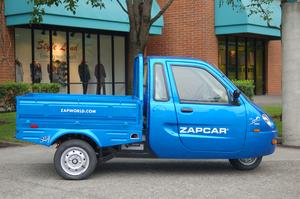
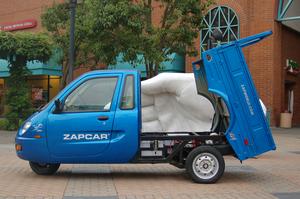
Pictures of the ZAP Xebra PK Truck.
March 7,2007 After a positive response for its Xebra Xero, electric car pioneer ZAP has designed a solar option for the three-wheeled electric workhorse - a photovoltaic panel that ZAP says can offer short-distance driving on sunlight alone. ZAP intends to showcase the new Xebra Xero (pronounced zebra zero) Truck at up-coming industry events for automotive fleets. The Xebra truck is a city car, available as a 4-door sedan or 2-passenger truck, good for city driving up to 40 mph and will cost about US$12,000 with the Xero Solar Panel Option. The car recharges normally by plugging into a standard 110 volt outlet for a full charge in up to six hours and a 50 percent charge in 1.5 hours. The ZAP Truck converts into a flatbed or dump-bed that can tilt to allow maximum exposure to the sun.
“If the Xebra Xero is exposed to sunlight during the day, and your commute is short, you can get pure solar powered driving,” says ZAP Chairman Gary Starr. “If you want to ensure 100 percent solar generated commuting, you can purchase a larger system that can sit on your rooftop.
“If the Xebra Xero is exposed to sunlight during the day, and your commute is short, you can get pure solar powered driving,” says ZAP Chairman Gary Starr. “If you want to ensure 100 percent solar generated commuting, you can purchase a larger system that can sit on your rooftop.
The potential use for the Xebra truck in the military would be for the national or state guard. I'm thinking of catastrophes such as Katrina or even smaller things such as hurricanes or tornadoes. When conducting humaniterian missions such as bringing food, clothing and water to people who's homes were destroyed. They could use The Xebra truck to transport these things. Its payload capacity as of now is 500 pounds. With research and development it could also serve as a miltiary base transport, transporting munitions, fuel, spare parts, etc to anywere on a base. Of course it would have to be worked on to get its payload capacity larger.
Monday, March 19, 2007
Interesting possibilites for the Army


The Venture Eclectic


Above are images of the Venturi Astrolab.
Venturi never ceases to amaze us with their eco-friendly creations. In addition to the already unique Eclectic and Fetish, we now have the world’s first commercially-available electric-solar hybrid in the form of the Venturi Astrolab. The car, which resembles a rolling wing with four wheels attached, is covered by 3.6 square metres of photovoltaic solar cells that enables it to reach speeds of up to 75mph with a range of 68 miles.
What we love most about Venturi is that most of their creations aren’t just fragile concepts that will never come close to any form of production. If you can afford the hefty €90,200 price tag then the Astrolab could be sitting in your garage once deliveries start in January 2008. The vehicle requires no fossil fuels whatsoever for its propulsion. Instead, power comes from a tiny 16kW engine that is recharged by the car’s motion or the sun’s rays.
To achieve its level of performance on such low power, the Astrolab was designed with extensive Formula One technology. Prime examples are its carbon monocoque ultra-light chassis and wind tunnel testing. Another cool feature is the Astrolab’s liquid cooled NiMH batteries that can be plugged into a mains socket for recharging. Though we doubt cars like the Astrolab will ever sell in respectable numbers, they do pave the way for a new generation of vehicles that one day we may all be driving.
What we love most about Venturi is that most of their creations aren’t just fragile concepts that will never come close to any form of production. If you can afford the hefty €90,200 price tag then the Astrolab could be sitting in your garage once deliveries start in January 2008. The vehicle requires no fossil fuels whatsoever for its propulsion. Instead, power comes from a tiny 16kW engine that is recharged by the car’s motion or the sun’s rays.
To achieve its level of performance on such low power, the Astrolab was designed with extensive Formula One technology. Prime examples are its carbon monocoque ultra-light chassis and wind tunnel testing. Another cool feature is the Astrolab’s liquid cooled NiMH batteries that can be plugged into a mains socket for recharging. Though we doubt cars like the Astrolab will ever sell in respectable numbers, they do pave the way for a new generation of vehicles that one day we may all be driving.
Why isn't the US Army investing in solar powered cars? Yes I realize its a very light car and the US Army's cars are much heavier. But by investing R&D funds into researching and developing solar powered cars we could increase the efficiency of solar cells that power cars. Another problem were working on is making solar cells less noticable and bulky. Also lets look at another concept that this company is developing.
Sitting alongside its Fetish sibling on the Venturi display at the Paris Motor Show is the self powered Venturi Eclectic. Touted as an autonomous energy vehicle, the Eclectic can be powered independently of any natural energy reserves. It’s powered by a small 22hp (16kW), 50Nm electric motor, and is normally charged up by the 2.5 square metres of solar cells on its roof.
The Eclectic is designed as a daily-driver for urban areas and more closely resembles a golf buggy than an actual car. Designer Sacha Lakic describes the vehicle as a “modern, autonomous and intelligent automobile.” The beauty of the Eclectic is that when it stands still, it’s actually adding energy to its batteries. In regions where the sun doesn’t shine that often, the vehicle uses wind power to rotate a force wheel, which generates electricity topping up the battery.
Complete charge of the liquid cooled NIMH batteries provides a range of about 50km and allows the car to reach speeds of 50 km/h. Wind power alone can drive the car 15km after a full day of charging. If all else fails, owners can simply plug it into a mains unit at home. The four-seater Eclectic weighs just 350 kilograms and will go into production in June 2007 with a price tag of 24,000 euros. Initially, only 200 units will be made but if they prove popular a cheaper version will be produced starting from 2009.
The Eclectic is designed as a daily-driver for urban areas and more closely resembles a golf buggy than an actual car. Designer Sacha Lakic describes the vehicle as a “modern, autonomous and intelligent automobile.” The beauty of the Eclectic is that when it stands still, it’s actually adding energy to its batteries. In regions where the sun doesn’t shine that often, the vehicle uses wind power to rotate a force wheel, which generates electricity topping up the battery.
Complete charge of the liquid cooled NIMH batteries provides a range of about 50km and allows the car to reach speeds of 50 km/h. Wind power alone can drive the car 15km after a full day of charging. If all else fails, owners can simply plug it into a mains unit at home. The four-seater Eclectic weighs just 350 kilograms and will go into production in June 2007 with a price tag of 24,000 euros. Initially, only 200 units will be made but if they prove popular a cheaper version will be produced starting from 2009.
Now again of course this car wouldn't survive in combat. But if the US Army modified it, it could serve as a great military installation patrol vehicle. That could save plenty of money while also demonstrating the capabilites of solar powered vehicles. It could also serve to develop an industry base for solar powered cars in America. I'm writing our senate and congress to bring this to their attention.
Friday, March 16, 2007
Document about what the DOD is doing to reduce energy cost's at its facilites.

Example of a solar tree grove in a parking lot.
Below are some examples of money their saving by doing different things like using renewable energy or using fluorescent bulbs.
Solar and Other Renewable Energy Sources
Cost-effective application of solar and other renewable energy sources is an important priority for DoD. The "Million Solar Roofs Initiative" is a commitment to use renewable solar energy wherever it makes sound economic sense. DoD’s plans include using over 3,000 solar applications on buildings by FY00, and 1,000 applications of photovoltaic technology on non-building systems.
Moanalua Terrace at Pearl Harbor, Hawaii, installed solar hot water heaters in 136 units of military family housing, and plans to install them in 516 additional units. DoD also installed photovoltaic applications at many test and training ranges in remote locations where utility power was not available. These were previously powered by diesel generators, costing as much as $2.00 per kWh. Photovoltaic power, by comparison, costs from $0.25 to $0.35 per kWh.
Eliminating the Use of Ozone Depleting Substances
Robins Air Force Base, Georgia, reduced ODS emissions by 99 percent and chemicals on EPA’s list of the 17 most hazardous chemicals by 89 percent from the 1992 baseline. The installation virtually eliminated methylene chloride use in paint stripping operations, resulting in annual savings of $790,000 for C-141 aircraft alone. Robins also implemented an ultraviolet light disinfection system at the sewage treatment plant, eliminating the use of 8,000 pounds of chlorine annually.
The Navy’s China Lake Energy Office, California, installed three unique photovoltaic projects on Santa Cruz Island, 8.5 miles from the mountaintop facility. These projects include a photovoltaic array that provides 139 kilowatts to a battery bank capable of holding 2.4 million watt hours. Another project is a water pump, powered by energy from the photovoltaic application, which provides water from 1,500 feet below the surface to the installation. In the initial year of the projects, the Navy saved $400,000 and expects to continue saving.
Improving Energy Efficiency at DoD Facilities
Fort Hood, Texas, is the U.S. Army’s premier installation for training and deploying heavy forces and has made great strides toward improving energy efficiency. Fort Hood’s Pollution Prevention Program is designed to improve cost savings and decrease emissions by preventing generation of solid waste, wastewater, and air emissions through source reduction, reuse, and recycling.
Fort Hood installed a parking lot solar lighting and an active daylighting system. The active daylighting system virtually eliminates all daytime electric lighting, equaling more than 1.4 billion Btus of renewable energy. In the future, each unit is expected to generate power equivalent to 600 to 800 fluorescent light bulbs, saving almost $20,000 each year. Just two panels of the parking lot solar lighting system produce 800 kilowatt hours (kWhs) per year, eliminating more than one ton of emissions. Combined, the two projects have saved approximately 2.5 billion Btus and $103,000. Fort Hood also installed vapor recovery systems on fuel tanks.
This document was from when Ale Gore was vice president as far as I know some things have changed. The main thing being the cancelation of the hybrid hummer program. Besides that as far as I know they have kept on schedule with the program. In fact because of the war in Iraq, the military is realizing even more so the economic sense of using renewable energy and developing alternative powered vehicles. One can only hope that this will catch on in the Air Force and Navy more. Another interesting possibility would be solar trees for military installations with huge parking lots. Solar tree's are basically solar panels that are supported by structures that also can serve to provide shade for vehicles. Right now the military is doing great at conserving power and using renewable energy at its facilites, the next step is for them to start working on making their ships, vehicles and aircraft more efficient. I'm starting to email our senators in the senate armed services committee.
Here is the list with links to their websites were you can then contact them on what issues you want.
Tuesday, March 13, 2007
Interesting Possibilites for the US Navy
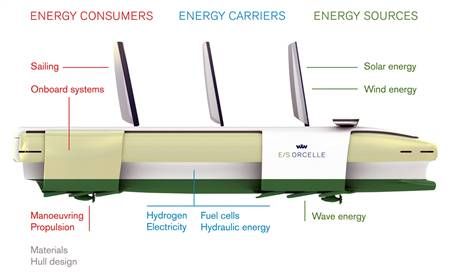
Wallenius Wilhelmson unveils a plan to build a solar, wind and tidal powered ship capable of transporting 10,000 cars from Britain to New Zealand.
The futuristic 'Orcelle' may be the first ship to use sun, wind and waves to propel its payload across oceans using renewable energy. A model of the ship is to be displayed at the World Trade Fair in Aichi, Japan in February 2005.
A spokesman for the Scandinavian company said: "This will be the first truly environmentally friendly ship, protecting the atmosphere and marine species". They have around 60 modern vessels that together carry 17 million vehicles a year by sea.820 feet long 'Orcelle' is shorter than the Queen Mary 2 (1,132ft) and the QE2 (963ft). The ship is called the E/S Orcelle after the Orcelle Dolphin - the French word for Irrawaddy dolphin, one of the world's most critically endangered species. The E/S stands for "environmentally sound ship". The vessel will include a cargo deck the size of 14 football pitches.
Wave energy is to be harnessed by 12 dolphin like fins an the ships hull. While, sun and wind energy is collected by three giant rigid wingsails, also covered in solar panels.
The cruise speed is in the region of 15 knots. Stability is provided by the shape of the Pentamaran hull - a slim monohull that will have two smaller support hulls know as sponsons on each side. You may recognise this layout as a Trimaran, or stabilised monohull (see Solar Navigator) in that there are essentially, three hull components in contact with the water.
The futuristic 'Orcelle' may be the first ship to use sun, wind and waves to propel its payload across oceans using renewable energy. A model of the ship is to be displayed at the World Trade Fair in Aichi, Japan in February 2005.
A spokesman for the Scandinavian company said: "This will be the first truly environmentally friendly ship, protecting the atmosphere and marine species". They have around 60 modern vessels that together carry 17 million vehicles a year by sea.820 feet long 'Orcelle' is shorter than the Queen Mary 2 (1,132ft) and the QE2 (963ft). The ship is called the E/S Orcelle after the Orcelle Dolphin - the French word for Irrawaddy dolphin, one of the world's most critically endangered species. The E/S stands for "environmentally sound ship". The vessel will include a cargo deck the size of 14 football pitches.
Wave energy is to be harnessed by 12 dolphin like fins an the ships hull. While, sun and wind energy is collected by three giant rigid wingsails, also covered in solar panels.
The cruise speed is in the region of 15 knots. Stability is provided by the shape of the Pentamaran hull - a slim monohull that will have two smaller support hulls know as sponsons on each side. You may recognise this layout as a Trimaran, or stabilised monohull (see Solar Navigator) in that there are essentially, three hull components in contact with the water.
http://www.solarnavigator.net/solar_transporter_orcelle.htm
This is an interesting idea, the difference between this post and my last post is this: The navy is actually investing in electric warships, the biggest program being the DDX advanced destroyer. Technolgies like this could also have an impact on saving fuel for amphibous transport ships. My question of course is this: Why isn't the military investing in technology like this? Especially with the recent gains in making solar cells more amorphous. Definition of amorphous;
Lacking definite form; shapeless.
Of no particular type; anomalous.
Lacking organization; formless.
Lacking distinct crystalline structure.
Not to mention the gains in wind power and tidal power infrastructure and technology. I think the potential of a renewably electric warship could be enourmous. It would be the perfect mix of sustainability and flexibility. Of course these ships would have to have huge batteries, but just think of it in this way: We develop small unmanned surface vessels that are electric these vessels could recharge at the bigger vessels and form a ring around carrier or amphibous battle groups to protect against terrorists using small boat swarm tactics. This ship would also be able to use different directed energy platforms; such as electro-magnetic or electro-chemical guns. The main difference between the current DDX design and my design is that it would be sustainable. Another possibility with this renewable energy is electro-magnetic armor for the ship when threats such as missiles or gunfire draw near. Depending on how big the battery is, the potentials are unlimited. I think we as Americans should start lobbying congress to fund projects like these and use our taxpayer money more wisely.
Interesting possibilites for the US Air Forces Aircraft
The Solar Impulse project aims to have a plane powered exclusively by solar energy take off and fly autonomously, day and night, to the point where it could circumnavigate the globe with no fuel, generating no pollution.
The pilots of the Solar Impulse, Bertrand Piccard, psychiatrist/adventurer, and André Borschberg, pilot/entrepreneur, have been leading the project since 2003. Beginning with the first flights, they will share the missions, as at the moment the aircraft can only carry one pilot at a time.
AERODYNAMIC
The wingspan of the aircraft measures 80 metres, slightly wider than the wingspan of an Airbus A380, in order to minimise drag and offer a maximum surface for solar cells. Such light wing loading (8 kg/m2) creates greater sensitivity to turbulence. The ultra-light structure must use customised carbon fibres.
Max. altitude
12,000 m
Max. weight
2000 kg
Average speed
70 km/h
Wingspan
80 m
Max. power of motors
35 kW
Battery weight
450 kg
Battery capacity
200 Wh/kg
Photovoltaic efficiency
0.2
http://en.wikipedia.org/wiki/Solar_Impulse
My question is this; Why isn't the military investing in solar powered aircraft? The effiency of these particular solar cells of course is terrible but as technology moves on maybe we will see enhanced 20 percent efficient solar cells on planes. This technology has a lot of potential to reduce the Air Force's fuel consumption. Right now the most efficient solar cells can transfer 40 % of the suns energy that hits them in to useable power. The potential savings are enormous, projects like this need more attention and I think the Air Force is a perfect example that can get more interest in solar powered planes.
The pilots of the Solar Impulse, Bertrand Piccard, psychiatrist/adventurer, and André Borschberg, pilot/entrepreneur, have been leading the project since 2003. Beginning with the first flights, they will share the missions, as at the moment the aircraft can only carry one pilot at a time.
AERODYNAMIC
The wingspan of the aircraft measures 80 metres, slightly wider than the wingspan of an Airbus A380, in order to minimise drag and offer a maximum surface for solar cells. Such light wing loading (8 kg/m2) creates greater sensitivity to turbulence. The ultra-light structure must use customised carbon fibres.
Max. altitude
12,000 m
Max. weight
2000 kg
Average speed
70 km/h
Wingspan
80 m
Max. power of motors
35 kW
Battery weight
450 kg
Battery capacity
200 Wh/kg
Photovoltaic efficiency
0.2
http://en.wikipedia.org/wiki/Solar_Impulse
My question is this; Why isn't the military investing in solar powered aircraft? The effiency of these particular solar cells of course is terrible but as technology moves on maybe we will see enhanced 20 percent efficient solar cells on planes. This technology has a lot of potential to reduce the Air Force's fuel consumption. Right now the most efficient solar cells can transfer 40 % of the suns energy that hits them in to useable power. The potential savings are enormous, projects like this need more attention and I think the Air Force is a perfect example that can get more interest in solar powered planes.
Subscribe to:
Posts (Atom)