The Smith Edison offers a payload of 2925 pounds, and a range of 150 miles per charge! I can imagine this vehicle delivering such things as supplies and mail too and around military bases in friendly countries.
http://www.smithelectricvehicles.com/products.asp?p=Edison
The Smith Newton can carry payloads up to 3.5 tons! And has a range of 130 miles per charge! It would be ideal for delivering such things as fuel, and spare parts too and around bases in friendly countries.
http://www.smithelectricvehicles.com/products.asp?p=NT
The Smith Faraday, has a payload of greater then two tons! The great thing about the Faraday is its variety of potential uses, it could be used as a recycling and trash pickup truck, while also having potential to deliver much needed supplies that need refigeration.
http://www.smithelectricvehicles.com/products.asp?p=Faraday
I think the US Military should be investing in such trucks. With modifications these trucks might even be able to operate in combat environements! Therefore saving the military hundreds of millions (if not billions) of dollars a year in transportation costs! And with much fewer parts then conventional diesel delivery trucks, the savings in maintenance costs would be astonishing!
Monday, February 4, 2008

Thursday, July 26, 2007
US Air Force, renewable energy for planes program!
The Air Force Office of Scientific Research here recently awarded the University of Washington and three partner universities a grant worth approximately $6 million over 5 years to study the design of air vehicles capable of collecting and storing solar and heat energies.
One of the goals of the research is to enhance Air Force air vehicle systems but there are many potential applications in other areas such as space platforms
While running air vehicles or space platforms, there are presently three main sources for harvesting energy with non-fossil origins – sunlight, heat, and vibration,” said Dr. B. L. “Les” Lee, program manager at AFOSR’s Aerospace and Material Sciences Directorate. The source of the heat energy, he said, can be aerodynamic heating caused by high flying speed or the recycling of waste heat around an aircraft cabin or engine. Each of the three sources, he explained, is capable of generating electricity, but sunlight and heat energies show the greatest potential in terms of significant power output. As a result, the proposed research will focus primarily on these two energy sources
Researchers will explore a variety of topics concerning materials and micro devices associated with so-called photovoltaic energy – or electricity generated from light sources – and thermoelectric energy – or electricity generated from heat sources. Once fully developed, these systems may one day enable air vehicles to fly solely on solar energy and aerodynamic heat. The systems may also find application in cabin operation on commercial airplanes
http://www.afosr.af.mil/News/nr_2006_29_solarHeatEnergies.htm
This is so awesome! First we use it in unmanned planes, then we use it in small manned planes. And then we just keep on progressing. Even if it didn't soley power an airplane, it could still reduce gas money! Looks like the Air Force is thinking smart now I tell ya. Although the money there allocating is pretty small. Hey you have to start somewhere! And here is the cool thing! If Air Force planes could be electricaly charged eventually. They could run on that for a little bit, intill the solar and thermal energy harvesting systems kicked in! I mean just think how quiet electric cars are, now apply that to a plane. I mean that would probably give a steath advantage of some sort. Another thing it would help with is thermal signature. Electric cars don't give off emmisions, electric planes won't either. And last but not least, the money savings. There will probably be four phases this technology will mature through.
1. Unmanned Aircraft Unmanned aircraft are usually pretty small and don't have half as much power needs as regular manned aircraft. Just think if we could power our unmanned fleet with solar and thermal energy. The money savings for fuel would probably be at least in the tens if not the hundreds of millions of dollars. This technology would also provide us with a potential to keep borders, etc, under surveliance for long periods of time.
2. Small Aircraft An example of a small aircraft would be the F22 Raptor, or JSF. The savings for using no fuel in these aircraft would be in the hundreds if not the billions of dollars.
3. Medium aircraft. The B2 Spirit or B52 bomber would be a medium sized aircraft. The savings for these aircraft would be the same as phase 2.
4. Big Aircraft. The C-130 or the AWACS, or even the JSTAR. Would be in this category. The savings would be on the phase two scale.
One of the goals of the research is to enhance Air Force air vehicle systems but there are many potential applications in other areas such as space platforms
While running air vehicles or space platforms, there are presently three main sources for harvesting energy with non-fossil origins – sunlight, heat, and vibration,” said Dr. B. L. “Les” Lee, program manager at AFOSR’s Aerospace and Material Sciences Directorate. The source of the heat energy, he said, can be aerodynamic heating caused by high flying speed or the recycling of waste heat around an aircraft cabin or engine. Each of the three sources, he explained, is capable of generating electricity, but sunlight and heat energies show the greatest potential in terms of significant power output. As a result, the proposed research will focus primarily on these two energy sources
Researchers will explore a variety of topics concerning materials and micro devices associated with so-called photovoltaic energy – or electricity generated from light sources – and thermoelectric energy – or electricity generated from heat sources. Once fully developed, these systems may one day enable air vehicles to fly solely on solar energy and aerodynamic heat. The systems may also find application in cabin operation on commercial airplanes
http://www.afosr.af.mil/News/nr_2006_29_solarHeatEnergies.htm
This is so awesome! First we use it in unmanned planes, then we use it in small manned planes. And then we just keep on progressing. Even if it didn't soley power an airplane, it could still reduce gas money! Looks like the Air Force is thinking smart now I tell ya. Although the money there allocating is pretty small. Hey you have to start somewhere! And here is the cool thing! If Air Force planes could be electricaly charged eventually. They could run on that for a little bit, intill the solar and thermal energy harvesting systems kicked in! I mean just think how quiet electric cars are, now apply that to a plane. I mean that would probably give a steath advantage of some sort. Another thing it would help with is thermal signature. Electric cars don't give off emmisions, electric planes won't either. And last but not least, the money savings. There will probably be four phases this technology will mature through.
1. Unmanned Aircraft Unmanned aircraft are usually pretty small and don't have half as much power needs as regular manned aircraft. Just think if we could power our unmanned fleet with solar and thermal energy. The money savings for fuel would probably be at least in the tens if not the hundreds of millions of dollars. This technology would also provide us with a potential to keep borders, etc, under surveliance for long periods of time.
2. Small Aircraft An example of a small aircraft would be the F22 Raptor, or JSF. The savings for using no fuel in these aircraft would be in the hundreds if not the billions of dollars.
3. Medium aircraft. The B2 Spirit or B52 bomber would be a medium sized aircraft. The savings for these aircraft would be the same as phase 2.
4. Big Aircraft. The C-130 or the AWACS, or even the JSTAR. Would be in this category. The savings would be on the phase two scale.
Friday, July 20, 2007
Air Force Solar Power Plant!
The largest solar power plant in North America will soon be providing electricity to an Air Force base in the Nevada desert.
The military says the plant, scheduled to power up at Nellis Air Force Base by the end of the year, shows that solar energy can effectively meet part of the country's energy needs. Despite three decades of development of the technology, solar energy is expensive, requires large amounts of space and taxpayer subsidies, and doesn't work at night or on overcast days.
Nellis, which is outside Las Vegas, is devoting 140 acres to a massive photovoltaic array with panels of silicon wafers that will rotate to follow the sun across the sky and generate electricity.
The plant will be capable of producing 15 megawatts of power, enough to provide 30% of the electric needs on the base, where 12,000 people work and 7,215 people live, Nellis officials say.
The Air Force expects to save $1 million a year in lower electric bills and to use the plant to demonstrate it is boldly advancing the use of renewable energy technology, a commitment of the Bush administration, Ohlemacher says. The Air Force will pay none of the construction costs. Instead, private investors will pay the more than $100 million projected capital cost, anticipating a steady flow of revenue from the Air Force for the electricity and substantial federal tax subsidies.
The project is being built in a complex arrangement between the Air Force and three financial partners:
•SunPower Corp. and its PowerLight subsidiary, California-based solar specialists that will construct the plant.
•MMA Renewable Ventures, a San Francisco company that will attract institutional investors to finance the project and own and operate the plant on land leased by the Air Force.
•Nevada Power, the local power provider, which will indirectly subsidize the Air Force's lower rates through payments to MMA Renewable Ventures.
MMA Renewable Ventures and its investors will take advantage of a 30% federal tax credit that Congress passed in 2005 and expires at the end of this year. Solar advocates are asking Congress for a 10-year extension as a way to keep solar electric economically viable. Investors also can take advantage of accelerated depreciation schedules for solar, an additional tax break, Tomlinson notes.
MMA and its investors will sell solar energy credits generated by the project to Nevada Power. The utility plans to use those credits toward meeting Nevada requirements that it obtain 20% of its power from renewable energy sources by 2015, says Tom Fair, Nevada Power executive for renewable energy. "Our goal is to bring more renewables into the system," Fair says.
http://www.usatoday.com/tech/science/2007-04-17-air-force-solar-power_N.htm
This is one of the most encouraging things I've ever heard about the US Militaries commitment to renewable energy. The only thing I don't like is that the Air Force is not investing its own money into the project. Based off my calculations instead of saving 1 million dollars a year, the air force could be saving 5 to 10 million dollars a year. That would mean payback on the cost of the system would be 10 to 2o years. And they would be actually be saving extra money not going into recouping the cost of the solar program after ten to twenty years. Just think of what they could do with all that extra money! Either way saving money is great if its 10 or 1 million dollars. And with those savings I woulnd't be suprised if they built a solar carport. I'm projecting an increase in commercial solar cell effiency from 22 percent or so to around 30 % in 8 or ten years. With 8 or ten million dollars saved up, coupled with government funding they could build a pretty huge solar carport. The one in San Diego generates around 1.25 megawats a year. And thats only for 446 cars. Just think of what they could do for Nellis Air Force Bases parking lot. They could probably save around a millon dollars a year. And I even had an idea for if they did pay upfront costs. Assuming they saved an average of 8 million dollars a year and put half of that to building a solar car port in ten years they could build a solar carport for the whole base and upgrade the buildings energy effiency. Another interesting possibilty for this base would be geothermal energy or heating. For gosh sakes its in the desert! Another thing that might help is a small wind turbine farm.
The military says the plant, scheduled to power up at Nellis Air Force Base by the end of the year, shows that solar energy can effectively meet part of the country's energy needs. Despite three decades of development of the technology, solar energy is expensive, requires large amounts of space and taxpayer subsidies, and doesn't work at night or on overcast days.
Nellis, which is outside Las Vegas, is devoting 140 acres to a massive photovoltaic array with panels of silicon wafers that will rotate to follow the sun across the sky and generate electricity.
The plant will be capable of producing 15 megawatts of power, enough to provide 30% of the electric needs on the base, where 12,000 people work and 7,215 people live, Nellis officials say.
The Air Force expects to save $1 million a year in lower electric bills and to use the plant to demonstrate it is boldly advancing the use of renewable energy technology, a commitment of the Bush administration, Ohlemacher says. The Air Force will pay none of the construction costs. Instead, private investors will pay the more than $100 million projected capital cost, anticipating a steady flow of revenue from the Air Force for the electricity and substantial federal tax subsidies.
The project is being built in a complex arrangement between the Air Force and three financial partners:
•SunPower Corp. and its PowerLight subsidiary, California-based solar specialists that will construct the plant.
•MMA Renewable Ventures, a San Francisco company that will attract institutional investors to finance the project and own and operate the plant on land leased by the Air Force.
•Nevada Power, the local power provider, which will indirectly subsidize the Air Force's lower rates through payments to MMA Renewable Ventures.
MMA Renewable Ventures and its investors will take advantage of a 30% federal tax credit that Congress passed in 2005 and expires at the end of this year. Solar advocates are asking Congress for a 10-year extension as a way to keep solar electric economically viable. Investors also can take advantage of accelerated depreciation schedules for solar, an additional tax break, Tomlinson notes.
MMA and its investors will sell solar energy credits generated by the project to Nevada Power. The utility plans to use those credits toward meeting Nevada requirements that it obtain 20% of its power from renewable energy sources by 2015, says Tom Fair, Nevada Power executive for renewable energy. "Our goal is to bring more renewables into the system," Fair says.
http://www.usatoday.com/tech/science/2007-04-17-air-force-solar-power_N.htm
This is one of the most encouraging things I've ever heard about the US Militaries commitment to renewable energy. The only thing I don't like is that the Air Force is not investing its own money into the project. Based off my calculations instead of saving 1 million dollars a year, the air force could be saving 5 to 10 million dollars a year. That would mean payback on the cost of the system would be 10 to 2o years. And they would be actually be saving extra money not going into recouping the cost of the solar program after ten to twenty years. Just think of what they could do with all that extra money! Either way saving money is great if its 10 or 1 million dollars. And with those savings I woulnd't be suprised if they built a solar carport. I'm projecting an increase in commercial solar cell effiency from 22 percent or so to around 30 % in 8 or ten years. With 8 or ten million dollars saved up, coupled with government funding they could build a pretty huge solar carport. The one in San Diego generates around 1.25 megawats a year. And thats only for 446 cars. Just think of what they could do for Nellis Air Force Bases parking lot. They could probably save around a millon dollars a year. And I even had an idea for if they did pay upfront costs. Assuming they saved an average of 8 million dollars a year and put half of that to building a solar car port in ten years they could build a solar carport for the whole base and upgrade the buildings energy effiency. Another interesting possibilty for this base would be geothermal energy or heating. For gosh sakes its in the desert! Another thing that might help is a small wind turbine farm.
Wednesday, April 18, 2007
Renewable Energy at Guantanamo Naval Base
Standing 275-foot tall, with blades spanning 177 feet, the Navy's four new 3-blade wind turbines are among the most noticeable features at Naval Station Guantanamo Bay, Cuba. Each of the four turbines will generate 950 kilowatts (kw) of electricity. Together, the four turbines will generate 3,800 kw, and in years of typical weather the wind turbines will produce almost 8 million kilowatt-hours of electricity. They will reduce the consumption of 650,000 gallons of diesel fuel, reduce air pollution by 26 tons of sulfur dioxide and 15 tons of nitrous oxide, and reduce greenhouse gas emissions by 13 million pounds each year.
The new wind turbines will provide as much as 25% of the base's power generation during the high-wind months of late summer, and are expected to save taxpayers $1.2 million in annual energy costs. The project began in July 2004 and cost nearly $12 million. Construction of the wind energy project was made possible through a partnership between the Navy and NORESCO of Westborough, MA as part of an energy savings performance contract (ESPC).
http://www.defenseindustrydaily.com/2005/04/wind-power-debuts-at-gitmo/
Here is what I am wondering, if four turbines provide 25% of the bases energy in good wind conditions. Then wouldn't 16 wind turbines provide 100% power to the base in good wind conditions?
"Before the wind turbines, Guantanamo Bay spent $31,000 a day -- $24 a minute -- on diesel fuel to run generators around the clock to produce electricity. Since the turbines went into operation about six weeks ago, they have been providing between 5 and 12 percent of the power the base uses.
Johnston noted that spring is the "slack-wind period" and that the turbines would be able to produce more power by July."
http://www.defenselink.mil/news/newsarticle.aspx?id=31070
With 16 turbines, the slack wind period energy for the base would theoretically increase to around 50 %. This would result in substantial energy savings. With say 24 wind turbines in operation it would increase theoretically to 75% in the slack wind period. Another renewable energy source for the base would be solar power. Its a very hot and sunny climate in Guantanamo bay. With enough efficient solar panels they could get the renewable power generation capacity up to 100 percent of the bases energy needs.
Now the interesting part comes when you think of the high wind period beginging in july. Twenty four wind turbines, plus solar power would be more then enough energy in the high wind periods. I now elude to my other post about renewable energy.
http://interesting-views-on-the-us-military.blogspot.com/2007/03/possibilites-for-us-army-continued.html
Pending research, my idea was for the military to use electric powered light utility vehicles for tasks around military bases. The excess of energy could be used to lend power to electric charging stations for light utility vehicles.
Any other excess of energy could be potentialy stored in energy banks.
The new wind turbines will provide as much as 25% of the base's power generation during the high-wind months of late summer, and are expected to save taxpayers $1.2 million in annual energy costs. The project began in July 2004 and cost nearly $12 million. Construction of the wind energy project was made possible through a partnership between the Navy and NORESCO of Westborough, MA as part of an energy savings performance contract (ESPC).
http://www.defenseindustrydaily.com/2005/04/wind-power-debuts-at-gitmo/
Here is what I am wondering, if four turbines provide 25% of the bases energy in good wind conditions. Then wouldn't 16 wind turbines provide 100% power to the base in good wind conditions?
"Before the wind turbines, Guantanamo Bay spent $31,000 a day -- $24 a minute -- on diesel fuel to run generators around the clock to produce electricity. Since the turbines went into operation about six weeks ago, they have been providing between 5 and 12 percent of the power the base uses.
Johnston noted that spring is the "slack-wind period" and that the turbines would be able to produce more power by July."
http://www.defenselink.mil/news/newsarticle.aspx?id=31070
With 16 turbines, the slack wind period energy for the base would theoretically increase to around 50 %. This would result in substantial energy savings. With say 24 wind turbines in operation it would increase theoretically to 75% in the slack wind period. Another renewable energy source for the base would be solar power. Its a very hot and sunny climate in Guantanamo bay. With enough efficient solar panels they could get the renewable power generation capacity up to 100 percent of the bases energy needs.
Now the interesting part comes when you think of the high wind period beginging in july. Twenty four wind turbines, plus solar power would be more then enough energy in the high wind periods. I now elude to my other post about renewable energy.
http://interesting-views-on-the-us-military.blogspot.com/2007/03/possibilites-for-us-army-continued.html
Pending research, my idea was for the military to use electric powered light utility vehicles for tasks around military bases. The excess of energy could be used to lend power to electric charging stations for light utility vehicles.
Any other excess of energy could be potentialy stored in energy banks.
Saturday, April 14, 2007
Interesting bio-fuel idea for the Army
A so-called “tactical bio-refinery” is another mobile system being pursued to convert field waste to energy. The system, which is built by Defense Life Sciences, McLean, Va., will convert paper, plastic, cardboard and food slop into bio-fuel gas to power a 60 kilowatt generator, Nolan said. The food waste goes into a bioreactor, where industrial yeast ferments it into ethanol, a “green fuel,” according to Purdue University, whose scientists are working with Defense Life Sciences. As an added benefit, the system helps to eliminate much of the waste on the battlefield.
The bio-refinery can save 115 gallons of fuel for every ton of waste converted, Nolan said. The first prototype has already been built and the full system will be ready for demonstration within 12 months, said Jerry Warner, founder of Defense Life Sciences.
On this project, the REF worked with the Defense Advanced Research Projects Agency.
Under a separate effort, DARPA is developing a mobile integrated sustainable energy system, or MISER. The idea is to take packaging materials — not garbage — from the field and convert them to generator fuel, which could eventually be used in a fuel cell.
Packaging materials account for a large amount of field waste — more than seven pounds per day per soldier. DARPA aims to reduce the cost and logistical burden of disposing the plastic packaging by harvesting it for energy.
The high-energy content of the plastic packaging — close to that of diesel fuel — makes it an ideal alternative energy source. “At today’s level of packaging being discarded, a military unit could achieve well over 100 percent self-sufficiency for its generator fuel needs,” according to a DARPA document.
http://www.nationaldefensemagazine.org/issues/2007/April/Alternativepower.htm
What I find more interesting is not the bio-fuels use for generator capacity. But its potential use as a fuel for military vehicles. I think we have a great idea for renewable power generators, with SkyBuilts idea. The mobile power station, which looks like a train container with solar cells and wind turbines.
http://www.skybuilt.com/mps.htm
All in all though, i'm glad the military is looking into alternatives.
Monday, March 26, 2007
Possibilites for the US Army continued.
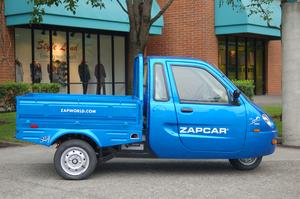
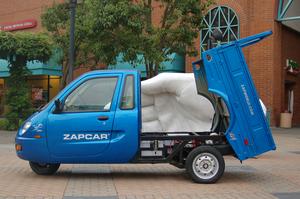
Pictures of the ZAP Xebra PK Truck.
March 7,2007 After a positive response for its Xebra Xero, electric car pioneer ZAP has designed a solar option for the three-wheeled electric workhorse - a photovoltaic panel that ZAP says can offer short-distance driving on sunlight alone. ZAP intends to showcase the new Xebra Xero (pronounced zebra zero) Truck at up-coming industry events for automotive fleets. The Xebra truck is a city car, available as a 4-door sedan or 2-passenger truck, good for city driving up to 40 mph and will cost about US$12,000 with the Xero Solar Panel Option. The car recharges normally by plugging into a standard 110 volt outlet for a full charge in up to six hours and a 50 percent charge in 1.5 hours. The ZAP Truck converts into a flatbed or dump-bed that can tilt to allow maximum exposure to the sun.
“If the Xebra Xero is exposed to sunlight during the day, and your commute is short, you can get pure solar powered driving,” says ZAP Chairman Gary Starr. “If you want to ensure 100 percent solar generated commuting, you can purchase a larger system that can sit on your rooftop.
“If the Xebra Xero is exposed to sunlight during the day, and your commute is short, you can get pure solar powered driving,” says ZAP Chairman Gary Starr. “If you want to ensure 100 percent solar generated commuting, you can purchase a larger system that can sit on your rooftop.
The potential use for the Xebra truck in the military would be for the national or state guard. I'm thinking of catastrophes such as Katrina or even smaller things such as hurricanes or tornadoes. When conducting humaniterian missions such as bringing food, clothing and water to people who's homes were destroyed. They could use The Xebra truck to transport these things. Its payload capacity as of now is 500 pounds. With research and development it could also serve as a miltiary base transport, transporting munitions, fuel, spare parts, etc to anywere on a base. Of course it would have to be worked on to get its payload capacity larger.
Monday, March 19, 2007
Interesting possibilites for the Army


The Venture Eclectic


Above are images of the Venturi Astrolab.
Venturi never ceases to amaze us with their eco-friendly creations. In addition to the already unique Eclectic and Fetish, we now have the world’s first commercially-available electric-solar hybrid in the form of the Venturi Astrolab. The car, which resembles a rolling wing with four wheels attached, is covered by 3.6 square metres of photovoltaic solar cells that enables it to reach speeds of up to 75mph with a range of 68 miles.
What we love most about Venturi is that most of their creations aren’t just fragile concepts that will never come close to any form of production. If you can afford the hefty €90,200 price tag then the Astrolab could be sitting in your garage once deliveries start in January 2008. The vehicle requires no fossil fuels whatsoever for its propulsion. Instead, power comes from a tiny 16kW engine that is recharged by the car’s motion or the sun’s rays.
To achieve its level of performance on such low power, the Astrolab was designed with extensive Formula One technology. Prime examples are its carbon monocoque ultra-light chassis and wind tunnel testing. Another cool feature is the Astrolab’s liquid cooled NiMH batteries that can be plugged into a mains socket for recharging. Though we doubt cars like the Astrolab will ever sell in respectable numbers, they do pave the way for a new generation of vehicles that one day we may all be driving.
What we love most about Venturi is that most of their creations aren’t just fragile concepts that will never come close to any form of production. If you can afford the hefty €90,200 price tag then the Astrolab could be sitting in your garage once deliveries start in January 2008. The vehicle requires no fossil fuels whatsoever for its propulsion. Instead, power comes from a tiny 16kW engine that is recharged by the car’s motion or the sun’s rays.
To achieve its level of performance on such low power, the Astrolab was designed with extensive Formula One technology. Prime examples are its carbon monocoque ultra-light chassis and wind tunnel testing. Another cool feature is the Astrolab’s liquid cooled NiMH batteries that can be plugged into a mains socket for recharging. Though we doubt cars like the Astrolab will ever sell in respectable numbers, they do pave the way for a new generation of vehicles that one day we may all be driving.
Why isn't the US Army investing in solar powered cars? Yes I realize its a very light car and the US Army's cars are much heavier. But by investing R&D funds into researching and developing solar powered cars we could increase the efficiency of solar cells that power cars. Another problem were working on is making solar cells less noticable and bulky. Also lets look at another concept that this company is developing.
Sitting alongside its Fetish sibling on the Venturi display at the Paris Motor Show is the self powered Venturi Eclectic. Touted as an autonomous energy vehicle, the Eclectic can be powered independently of any natural energy reserves. It’s powered by a small 22hp (16kW), 50Nm electric motor, and is normally charged up by the 2.5 square metres of solar cells on its roof.
The Eclectic is designed as a daily-driver for urban areas and more closely resembles a golf buggy than an actual car. Designer Sacha Lakic describes the vehicle as a “modern, autonomous and intelligent automobile.” The beauty of the Eclectic is that when it stands still, it’s actually adding energy to its batteries. In regions where the sun doesn’t shine that often, the vehicle uses wind power to rotate a force wheel, which generates electricity topping up the battery.
Complete charge of the liquid cooled NIMH batteries provides a range of about 50km and allows the car to reach speeds of 50 km/h. Wind power alone can drive the car 15km after a full day of charging. If all else fails, owners can simply plug it into a mains unit at home. The four-seater Eclectic weighs just 350 kilograms and will go into production in June 2007 with a price tag of 24,000 euros. Initially, only 200 units will be made but if they prove popular a cheaper version will be produced starting from 2009.
The Eclectic is designed as a daily-driver for urban areas and more closely resembles a golf buggy than an actual car. Designer Sacha Lakic describes the vehicle as a “modern, autonomous and intelligent automobile.” The beauty of the Eclectic is that when it stands still, it’s actually adding energy to its batteries. In regions where the sun doesn’t shine that often, the vehicle uses wind power to rotate a force wheel, which generates electricity topping up the battery.
Complete charge of the liquid cooled NIMH batteries provides a range of about 50km and allows the car to reach speeds of 50 km/h. Wind power alone can drive the car 15km after a full day of charging. If all else fails, owners can simply plug it into a mains unit at home. The four-seater Eclectic weighs just 350 kilograms and will go into production in June 2007 with a price tag of 24,000 euros. Initially, only 200 units will be made but if they prove popular a cheaper version will be produced starting from 2009.
Now again of course this car wouldn't survive in combat. But if the US Army modified it, it could serve as a great military installation patrol vehicle. That could save plenty of money while also demonstrating the capabilites of solar powered vehicles. It could also serve to develop an industry base for solar powered cars in America. I'm writing our senate and congress to bring this to their attention.
Subscribe to:
Posts (Atom)